

CASE STUDY · REMOTEDESK PRIVATE LIMITED
The company that builds Efforti runs on Efforti.
~120 people across product, engineering, QA, CS, support, sales and marketing, asked daily by agents, briefed to leadership every morning. This is the live workspace, described honestly: what runs, what it surfaces, and what a Wednesday looks like for the CEO.
From the live workspace · July 2026
The rhythm
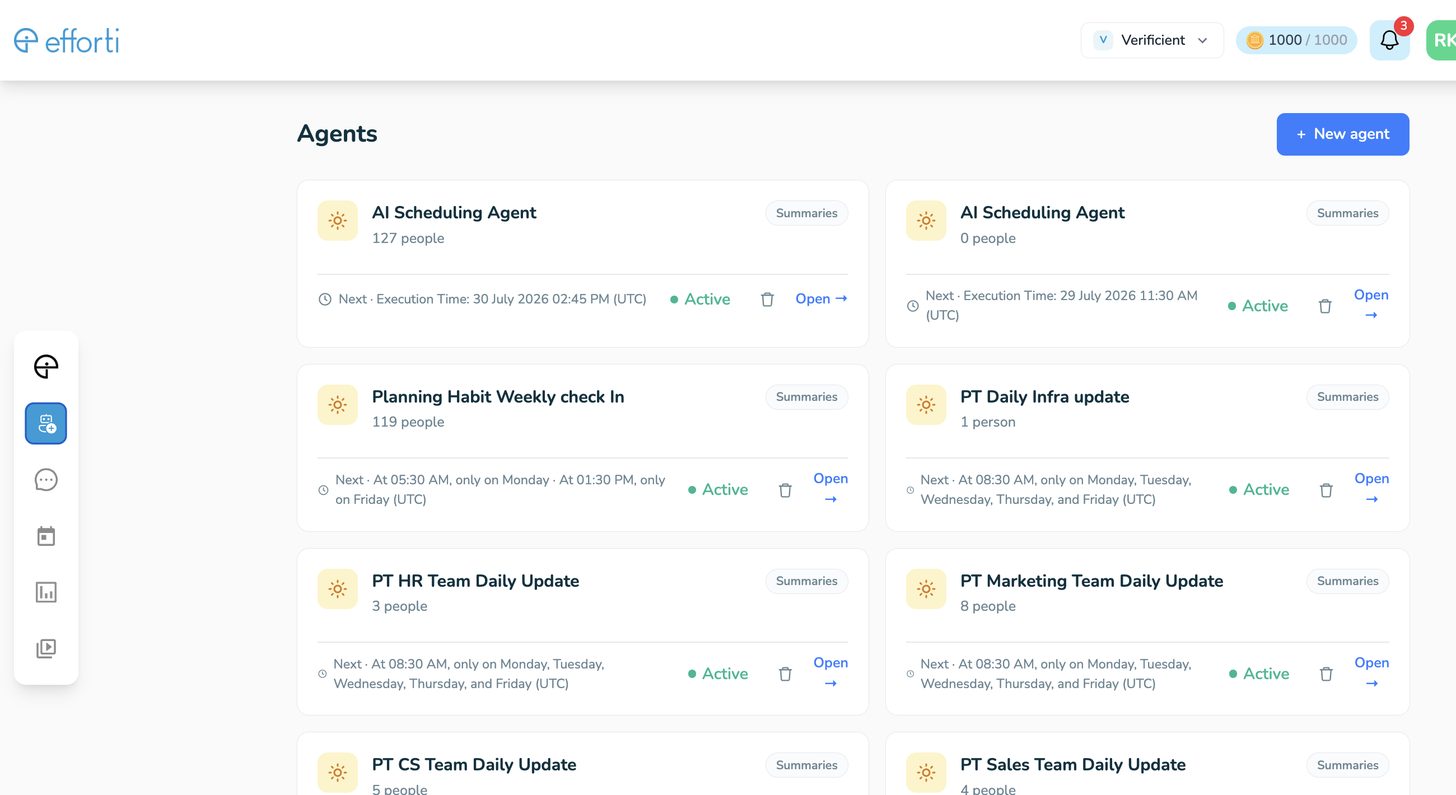
Every function, its own agent. One briefing at the top.
Daily task updates for product, QA, CS and support pods. Weekly outcome check-ins with rocks-style commitments. Sprint updates carrying a say/do ratio. Weekly escalation readouts with resolution rates. Quarterly roadmap confirmations from team leads. Each agent fires on its own schedule, in each person's timezone, and every reply lands in one synthesis instead of fourteen channels.
The Wednesday test
“Blockers: 13 themes. None waiting on you.”
On a July Wednesday, the CEO's Team Performance Check classified thirteen open blocker themes across the org: every one attributed to an external dependency, a process, or a peer team, with its age attached. The reading took a minute; the conclusion, nothing here needs me personally, is the kind of sentence a leader otherwise buys with five meetings. A colleague out sick surfaced the same morning, with the dependency on their work named, before any deadline exposed it.
Blockers (6 themes, 0 on you / 6 external · process):
- Asha Nair: Crestline UAT sign-off waiting on client External · ~2d
- Rohan Mehta: staging access for the new QA pair Process · ~5h
- Meera Pillai: Atlas demo environment blocked on data refresh Backend · ~1d
This week so far:
- Daily standup: 34/38 (89%) replied. Sprint on track, two rocks at risk.
- Weekly outcome & score: 51/54 (94%), say/do ratio at 85%.
- Escalations update: 88% resolved, 1.6h average time.
Silences: 1
- Dev Kapoor: second quiet day. Open items attached; nudge drafted. Send?
Sara D'Souza → Design daily (fired 2:00 PM, replied 2:55 PM): handoff files shipped.
The honest part
Adoption is a curve, and the product shows it.
Not every agent gets a 90% reply rate on day one. The workspace's own adoption view says so, per team, per agent, with silences named. That's the point: the numbers are real because the product refuses to pretend otherwise. Reply rates climb where leads act on the briefing; the agents send exactly one polite reminder either way, because chasing was the disease, not the cure.
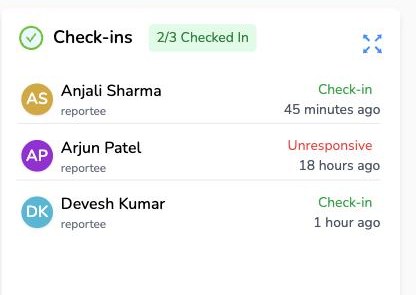
- Fired-at and replied-at timestamps on every check-in
- Late replies flagged, never punished; silence is visible, not scored
- The adoption view tells leadership where to invest next
Your org can read like this by next Wednesday.
Open a sample dashboard, then point one agent at one team. The briefing does the convincing.